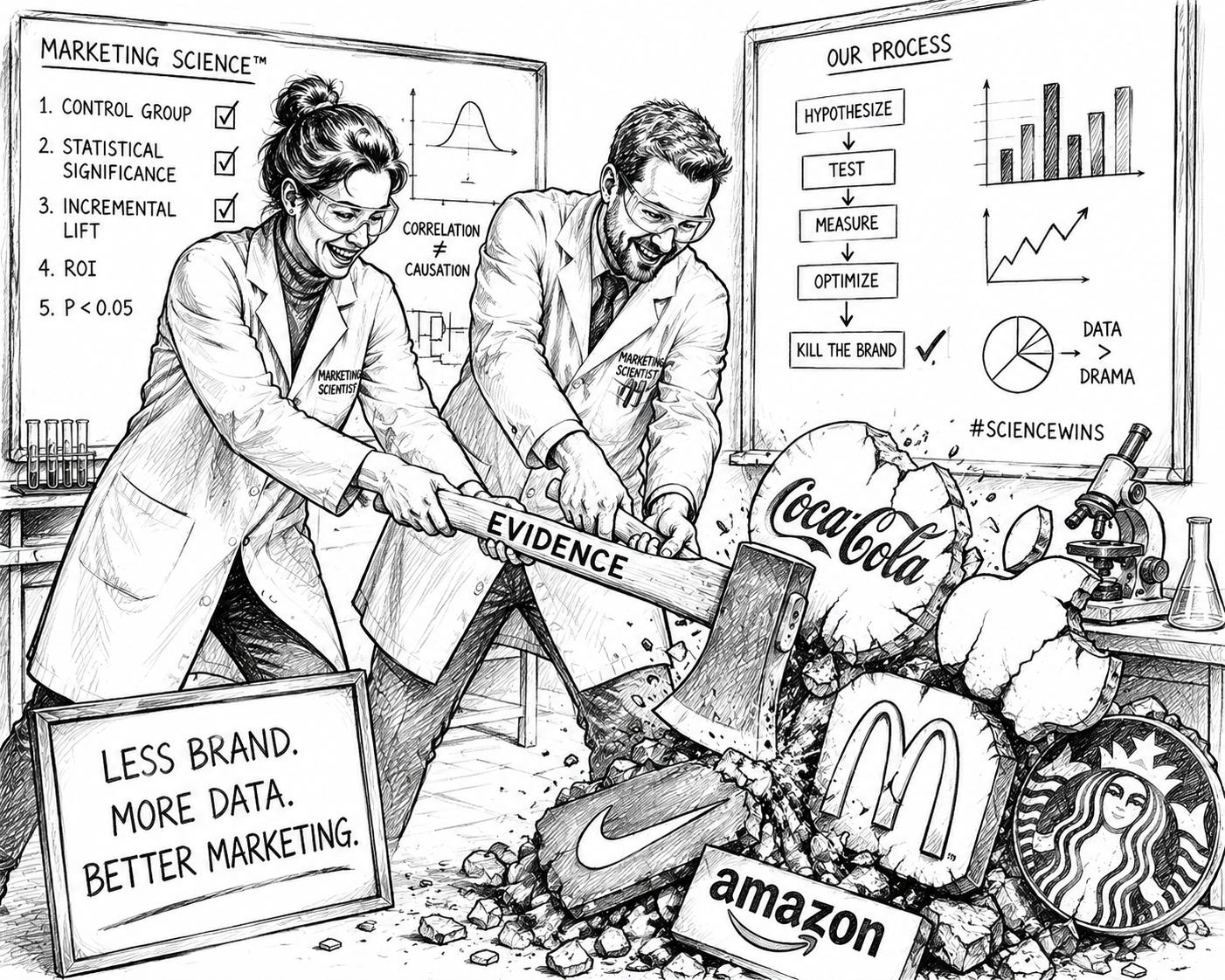
Is science is killing marketing?
If it is, it’s the second career I’ve had where science has come in hard and almost fucked it.
Adam is a friend, a consumer psychologist, and one of the sharpest minds in advertising — he went from clinical psychology to co-founding one of the most awarded creative agencies going, which makes him one of the few people actually qualified to ask whether the science is strangling the craft.
This one hit home because CRO has the exact same tension. We preach data and evidence all day, but the best wins usually come from a creative leap the numbers hadn’t approved yet. Read it with your testing roadmap in mind.
Is science is killing marketing?
If it is, it’s the second career I’ve had where science has come in hard and almost fucked it.
The first was psychology. Psychology is built on the “scientist practitioner model” —that is, the science informs what the clinician practices. That mindset is what stopped psychology being a bunch of psychodynamic psychobabble. Back in the day, Freud and his talented disciple Jung played with mythology aand pretended they knew what they were doing.
Then along came the behaviouralists and placed science into the mix. When I entered the workforce I proudly declared myself a practitioner of hardcore CBT (cognitive behavioural therapy) and attempted to change behaviour according to the textbook.
My only big win was with a young woman who’d had to leave the workforce (she worked for NSW Transport) due to a fear of moths. After a six-week course of systematic desensitisation, we cured her fear of moths and got her back into the subway (Sydneys underground train), and back into the workforce.
Of all the patients I ever had, she’s the only one I can say left truely cured.
As a client (an inmate in the prison system), once said to me: “Psychologists don’t help, they soothe.” I love that so much.
To this day I think psychology, desperate to be seen as legitimate, has over-claimed its scientific foundations in an effort to compete with the more highly esteemed (and highly paid, yet probably even less effective) profession of psychiatry. The evidence-based model has beaten the creativity and humanity out of psychology, and I can see it happening in marketing.
In psychology, what makes a difference is empathy, human connection, and the ability to be creative with what’s actually going to work for the situation in front of you. Every situation is contextually different and multi-faceted enough that leaning on the bluntness of science just doesn’t get us far.
There are too many gaps. It’s these gaps I find fascinating, the bits where the evidence hasn’t reached yet… and may never reach. If we don’t accept the gaps, and don’t take leaps of faith and proudly do what the evidence hasn’t said is possible (yet?), then how do we do our best work? Just do what the science says works? If that’s the standard, I’d argue that’s average marketing done well, which, to be fair, is probably still better than most marketing.
Marketing science is a useful but very small subset of what makes marketing work. Treating it as the whole picture doesn’t make marketing better. It makes marketing worse; smaller, safer, and further from the thing that actually moves people. The marketing science voices are getting a little earnest and overzealous. It’s the same thing I saw in psychology. Back off, marketing isn’t rocket science or brain surgery. It’s both much more important and much harder than either.
Marketing is the cornerstone of every facet of our society. Good marketing (with a full 4Ps mindset) underpins everything from the Catholic Church and Islam to our judicial system and parliament. All of these institutions have great marketing: a strong product, distinctive brand assets built up over many years, strong overlapping mental and physical availability, and in the ase of religions - excellent pricing strategies.
But unlike rocket science and brain surgery, marketing is genuinely difficult in a different way. You can’t just read about it in a book and go practice it. You can’t just study it at university or do a short course and become good at it. Marketing deals with psychology, creativity, social psychology, emotion, persuasion, making things, distribution, entrepreneurialism…everything.
The marketing science voices are well-meaning but often distracting. They’re the ones who complain about marketers only focusing on one P (promotion - specifically the paid bit of promotion), yet that’s what they themselves preach about 95% of the time. When the loudest educators in the market only focus on one P, it makes it harder for the rest of us to convince our organisations that marketing is a whole-of-business pursuit. Should we be calling marketing science ‘Promotion Science’?
And on the other Ps? Marketing science has almost nothing to say:
Pricing: a handful of models from the 1960s and a lot of A/B testing, but little real science.
Place: next to nothing.
Product: a few absurd studies on innovation, and that’s about it.
Three-quarters of the marketing mix, and the science barely shows up. Even our modern marketing bible - ‘How Brands Grow’ ignores most of marketing with an approximate 70% 20%, 5%, 5% weighting to promotion, place, pricing and product respectively.
Knowing the science to understand marketing is a bit like knowing the Earth to understand the Universe… woefully inadequate. There’s so much we don’t know, and let’s not be blind to it. I believe they call this terra incognita: the stuff we don’t know.
Even where we’ve made leaps of understanding such as with MMM, long-term vs. short-term marketing and sales, even the classic John Wanamaker line “half my advertising is wasted, I just don’t know which half” — it’s still firmly rooted in the one P. (I’ll save the bastardisation of science in advertising testing for another day).
How much less advertising do I need to do if my product is really good?
How long does a good event stay in a consumer’s mind vs a good social media post?
Why can Aesop build its brand on sampling, cool packaging, and interior design when others can’t?
Why did Squid Game become a global hit?
What’s the marketing science behind Taylor Swift?
What’s the impact on Football Team X after communications disaster Y?
How do I create the next billion-dollar brand?
What do I do with this legacy brand — mass awareness, mass distribution, declining sales?
Dear marketing science: we love you, and we embrace the meagre influence you have. Just don’t fuck it up by overstating your own importance.